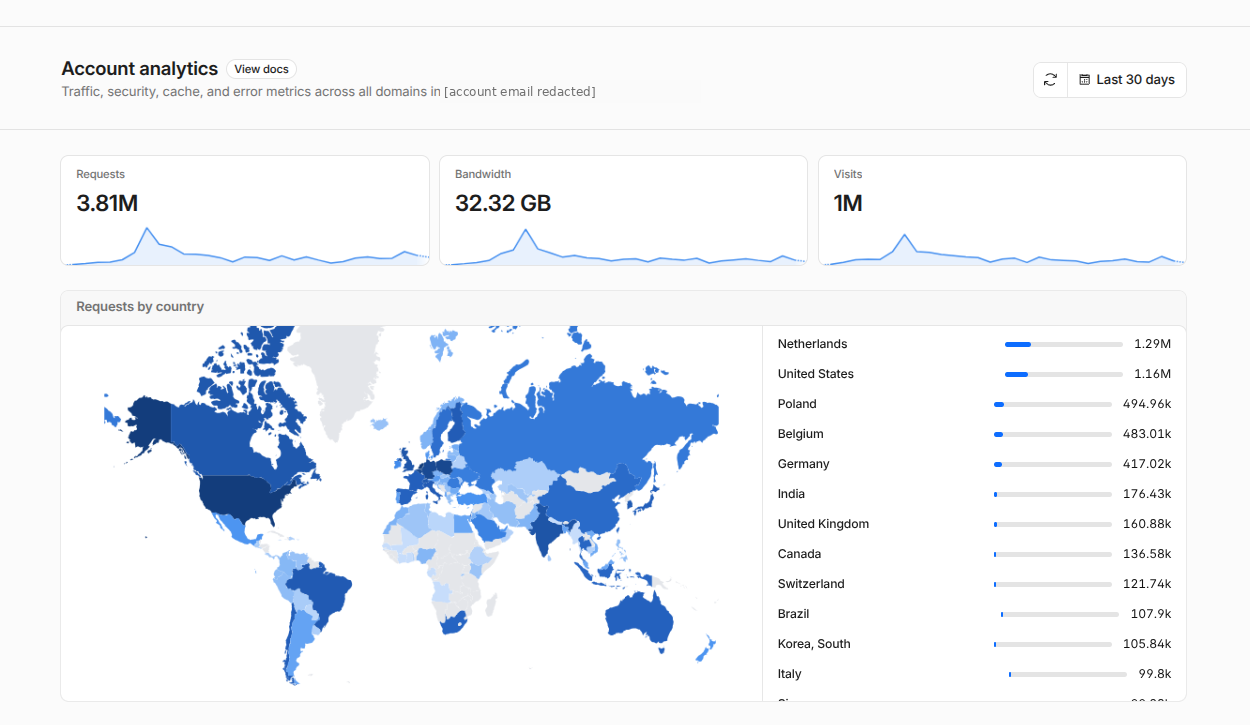
Exhibit A · Cloudflare account analytics · last 30 days
One million visits. Not one million people.
On 18 November 2026 my Cloudflare dashboard showed 3.81 million requests, 32.32 GB of bandwidth and 1M visits across every domain on my account. I am keeping the screenshot as evidence. This page exists so that I — and any later version of me — remember exactly what it is evidence of.
The original screenshot, with the account email redacted. Nothing else altered. Tap the stamp.
Three numbers, one window (the 30 days before 18 Nov 2026), one scope: all domains on the account — the main site, every subdirectory Worker, every Pages project, every subdomain, every 404 and every robot that knocked. Here is what each number is, in Cloudflare's own terms, and what it is not.
3.81M
Requests
Is: every HTTP request Cloudflare answered — HTML, stylesheets, scripts, images, fonts, robots.txt, sitemaps, redirects, errors. Cloudflare notes that one ordinary page view usually takes many requests.
Is not: people, readers, or even page views.
32.32 GB
Bandwidth
Is: the bytes sent back in responses from Cloudflare's edge.
Is not: attention. A crawler downloading a page and a person reading it for ten minutes cost the same bytes.
1M
Visits
Is: a page view (a successful HTML response) whose referrer didn't match the site's own hostname — someone or something arriving from elsewhere, or arriving with no referrer at all. One visit can include several page views.
Is not: unique visitors. Most automated clients send no referrer, so they qualify comfortably.
02 The Sieve
Hypothesis machine
Only the top layer is data. Every layer below it is a guess, and the guesses are yours. Move them and watch how much the answer depends on what you assume.
Floor is 26.3%: page views can't be fewer than the 1M visits.
≈ — people (a guess)
03 Arithmetic that needs no guessing
Fact (division)
32.32 GB ÷ 3.81M requests≈ 8.5 KB per request
32.32 GB ÷ 1M visits≈ 32 KB per visit
Netherlands + United States2.45M of 3.81M requests ≈ 64%
India — where I live, and where most people who know me live176.43k ≈ 4.6%
Interpretation
The HTTP Archive measures a typical modern web page in megabytes, not kilobytes. If a million people had each loaded a full page with its images and scripts, I would expect the bandwidth to look closer to a terabyte than to 32 GB. Caching, compression and very light pages pull that number down, so this is not proof. But 32 KB per visit is what you would expect if most visits were something fetching the HTML and leaving — which is what crawlers do.
04 You, measured
Fact (from your own browser, nothing sent anywhere)
Measuring this page load…
05 Where the requests came from
Fact (from the screenshot) · notes are hypotheses
“Country” means where the connecting IP address is geolocated — not where a human sits. A crawler running in a Dutch data centre counts as the Netherlands. Someone in Delhi on a VPN might count as Switzerland.
Select a country to read the note.
06 What would actually count as proof
If the question is “are humans reading my work?”, these are better instruments than a request counter — each is closer to a person choosing something:
Search Console clicks. A person saw a results page and chose my link. In an October 2026 audit, Google Search Console showed roughly 19 organic clicks and 329 impressions over 28 days. Different instrument, different window — not comparable to this dashboard, but an honest reminder of scale.
A JavaScript beacon. Privacy-first tools such as Cloudflare Web Analytics count only browsers that run a script; many simple crawlers never do.
Bot classification. Verified-bot and bot-score breakdowns, where the plan offers them, separate declared crawlers from browsers.
Replies. Emails, messages, citations, someone quoting a line back to me. Small numbers, high signal.
The same receipt, next month. One snapshot proves little; a series with the same window and scope shows direction.
The same October audit found 1,301 of 2,311 candidate URLs returning 404. Every one of those is still a request. Some of this screenshot is machines patiently asking for pages that no longer exist.
07 Note to a future me
Sahil —
You will be tempted to read the big number as an audience. It isn't. It is a record of how much of the internet's machinery pointed itself at your domains for a month. That is still worth something: it means the sites are reachable, indexed, crawled, fetched by search engines and AI systems — and in 2026 that machinery is part of how people find anything. Keep the screenshot. Just keep it labelled.
A request is a handshake, not a reader.
Count what you want, not what is easy to count. When a measure becomes a target, it stops measuring (Goodhart).
Ask: what would produce this number if no human existed? If the answer is “most of it”, say so first.
Geography here is IP geography.
Compare like with like — same dashboard, same window, same scope.
Separate fact, interpretation and hope, out loud, on the page.
Be glad of the humans you can name. They were never going to show up in this chart as themselves.
— Sahil, 18 Nov 2026, written with Claude
08 Monthly re-check ritual
Saved in this browser only.
09 Glossary
Request
One HTTP ask-and-answer between a client and a server. A page with ten images is at least eleven requests.
Page view
In Cloudflare's dashboards, a successful response whose content type is HTML.
Visit
A page view whose referrer doesn't match the hostname — arriving from elsewhere or with no referrer.
Unique visitor
An attempt to count distinct clients, usually by IP address over a period. Shared IPs, VPNs and mobile networks blur it both ways.
Referrer
The header a browser may send saying which page linked here. Bots and privacy settings often omit it.
Crawler / bot
Software that fetches pages automatically: search indexers, AI crawlers, uptime monitors, link checkers, scrapers. Polite ones read robots.txt.
Edge / CDN
Cloudflare's servers close to the requester. They answer, cache and count before anything reaches the origin.
Goodhart's law
When a measure becomes a target, it ceases to be a good measure.