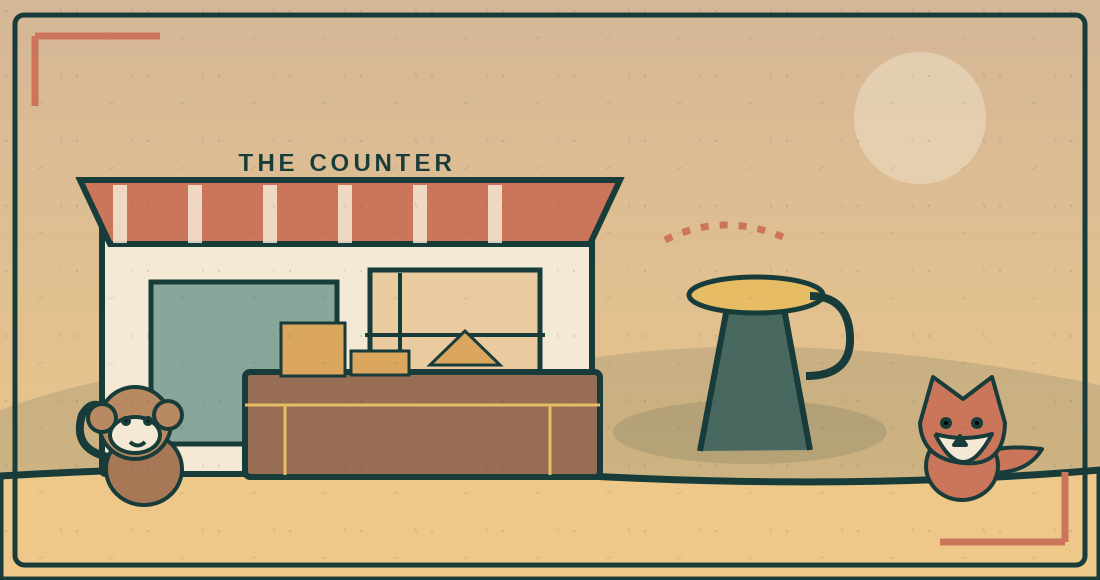
The Shop Counter
Warm dust, paper bags, cold coins, an overhead fan turning as though it has a union agreement.
Moss the monkey taps a ledger. “The world appears philosophical right up to the moment it needs change for a hundred.”
Vela the fox studies the shelves. “Beware romanticising labour that someone else cannot choose to leave.”
The shop is not a metaphor pretending to be a shop. It is a place with inventory, fluctuating demand, impatient customers, missing change, spoiled fruit, and the small algebra of keeping promises. A visitor arrives wanting to discuss a grand theory of what matters. Before the first sentence is finished, somebody asks whether the kettle is working. The question about life is not postponed; it changes shape. Intelligence, here, is the capacity to notice what the moment asks without assuming that one vocabulary can answer every request.
Listen to the counter. A customer wants credit until Friday; another has arrived with a complicated complaint; a child is deciding whether to spend a coin on something dazzling or ordinary. There are real boundaries: giving endlessly can wreck a small business, and enforcing every rule without attention can wound the people a neighbourhood depends upon. The shopkeeper has no perfect algorithm. Judgment appears in the pause between what is permissible, what is affordable, and what would be decent. Mistakes must be paid for in currency and in trust.
Many stories about freedom begin by escaping routine. But freedom can also mean acquiring enough practical competence to keep a small promise. The point is not that work is sacred or that hardship is secretly good for the soul. Sometimes work is simply exhausting. Yet the counter remembers something a roadmap to greatness can forget: other people exist in the story, not only as audience, employers, customers, or obstacles, but as persons with weather of their own. A question worth carrying is not “How far did I climb?” but “What did my decision make possible for someone else?”
The pencilled account
A regular customer asks to pay later. The previous debt has not been cleared. The shelves need restocking tomorrow. What do you do?
- Offer a small, clearly bounded extension. — Moss writes a date in pencil. “Generosity needs a number, too. Otherwise it can become a promise paid for by somebody not consulted.” Vela nods, but asks whether the boundary can be explained without humiliation.
Question: When is an exception fair to everyone affected?
- Keep the limit, explain it with care. — Moss puts the pencil down. “A no spoken carefully may protect tomorrow’s yes.” Vela adds that a rule is not compassionate merely because it is consistent; its effects still deserve examination.
Question: Can a boundary be kind without becoming an excuse?
The kettle on the side
The kettle whistles while the queue grows. An exhausted stranger asks for water. What receives your attention?
- Pause briefly, make space for water. — The queue shifts. Nobody becomes enlightened. Somebody becomes less thirsty. Moss calls this “a modest miracle with a perfectly ordinary price tag.”
Question: What small need is invisible from a distance?
- Ask a neighbour to help while you serve. — The kettle passes to another pair of hands. Vela approves of distributed attention: “Care need not always mean doing everything yourself.”
Question: When is asking for help an act of care?
The Perfumer’s Bench
Orange peel, cedar shavings, cold glass, and something impossible to name accurately on the first attempt.
Moss sniffs a paper strip and announces, “This one smells like a rainy Tuesday attempting diplomacy.”
Vela marks the formula sheet. “Description is not ownership of someone else’s memory.”
On the bench are small bottles and an unglamorous stack of failed trials. A scent that seemed graceful on paper becomes harsh in a blend; a quiet material becomes strangely beautiful when it has time to settle. Craft is the art of learning to distinguish your first enthusiasm from what remains after the excitement moves on. Nobody can inspect a single bottle and infer the maker’s character. The craft asks for repeated attention, decent ventilation, careful materials, and the courage to keep an honest notebook.
An apprentice insists that a fragrance must mean exactly the same thing to everyone. The perfumer places two blotters on the table. “Describe them,” she says. One visitor remembers a relative’s wardrobe. Another thinks of pencil cases. The molecules have not changed; the lives meeting them have. This does not make every interpretation chemically correct, nor does it permit the seller to claim a perfume can cure distress. It means that sensation passes through experience before it becomes a sentence. Language is a useful lantern, not a prison for the nose.
Learning here is gloriously inconvenient. The useful lesson may be a restraint: do less, wait longer, measure again, admit that a favourite note does not belong in every composition. The customer who wants an answer today deserves an honest answer today, even when that answer is that a promise would be premature. There is wonder in precise technique, and there is an ethics to refusing to oversell wonder. Before you leave, the bench gives you a question: what work in your life becomes richer when nobody is watching you improve?
The unfinished formula
A beautiful opening fades into a disappointing drydown. The label deadline is tomorrow. What next?
- Delay the claim and revise the blend. — The notebook stays open. “A deadline is a fact, not an alibi for an inaccurate label,” Vela says. Moss sighs: “My dramatic launch speech has been postponed by chemistry.”
Question: What deserves a second trial rather than a polished announcement?
- Release a small test with plain limitations. — The label becomes less glamorous and more accurate. Moss calls it “the limited edition of being specific.” Vela asks how testers will know what they are consenting to try.
Question: How can a work-in-progress be offered without overselling it?
The borrowed memory
A guest says your scent reminds them of someone they miss. They ask what the fragrance was “meant” to evoke.
- Ask what it evokes for them, without claiming to know. — You learn that the scent belongs to a story you could never have written. The guest gets to keep it. Vela smiles at a boundary nobody had to defend loudly.
Question: Whose meaning is it when art meets a life?
- Share your intention, then invite disagreement. — The guest laughs: your summer orchard was their old bus depot. Both descriptions survive. Moss declares the bus depot unexpectedly poetic.
Question: Can an intention coexist with an unexpected interpretation?
The Theatre Greenroom
Dust in a spotlight, oranges in a bowl, velvet curtains, stage paint, applause leaking through a wall.
Moss emerges with a cardboard crown. “At last, a leadership position requiring no meetings.”
Vela adjusts a mirror. “A role is not a lie, but it is rarely the whole person.”
Behind the stage, everyone is someone twice. There is the person who waits for the cue and the character who crosses into the light. A confident performer may need reassurance five minutes before the curtain. The shy stagehand may be the most reliable mind in the room. To say that identity is performed is not to say that nobody is sincere. Roles coordinate shared life. A teacher, a friend, a shopkeeper, and a beginner each require different emphases. Trouble begins when a useful part insists it is the only possible whole.
A director offers you a costume that makes the audience applaud before a word is spoken. A stagehand offers you a small job without a spotlight. Neither is pure. Visibility can create opportunities to do good work; invisibility can shelter avoidance as easily as humility. The greenroom refuses the cheap moral in which applause is corrupt and obscurity automatically authentic. It asks what you are doing with the attention you have, whether you can give credit accurately, and whether the performance leaves you more or less available to other people.
On a hook hangs a name badge from a play that closed years ago. Someone has kept it for sentimental reasons. The attachment is understandable. We all carry descriptions that once helped us organise the world: impressive, unreliable, brave, careful, creative, practical. Some descriptions were handed to us by others. Some are aspirational. Some may have expired without our permission. The room offers neither a demand to strip off every costume nor a command to become the loudest version of yourself. It leaves one exquisite, awkward possibility: you can rehearse a better behaviour without pretending you have already become its embodiment.
The curtain call
A performance succeeds, and the audience credits you alone. The stagehand is packing the lights.
- Name the unseen collaborators aloud. — The spotlight does not shrink. It becomes less lonely. Moss quietly returns his crown to the prop box.
Question: Who made a visible success possible?
- Thank the crew personally, then correct the programme. — The public record changes and the private relationship gets its own attention. Vela notes that recognition should reach the places where it matters.
Question: Which kinds of gratitude require a public record?
The fitting mirror
A costume gives you a persuasive new voice. You enjoy how easily people believe it. What will you do with the mask?
- Use the courage, without exaggerating the biography. — Your borrowed voice carries a true sentence. Vela: “A rehearsal can prepare a real act. It cannot manufacture a past.”
Question: Where does useful rehearsal become impersonation?
- Take it off for a difficult conversation. — Without the costume your answer is slower. The conversation remains possible. Moss is briefly disappointed, then offers you the better-fitting shoes.
Question: When does plainness serve a conversation better than theatre?
The Footnote Library
Old paper, lemon polish, a staircase that seems to spiral into a paragraph, and rain on the skylight.
Moss follows a footnote marked “see also” and returns with an atlas of nineteenth-century umbrellas.
Vela shuts a volume softly. “A detour may be delightful. It is not a substitute for answering a promise.”
This library began with one shelf and a disagreement about how to shelve a map. The disagreement produced a catalogue, the catalogue produced an index, and the index produced a room dedicated to things that no longer fit the catalogue. The collection is an affectionate monument to human curiosity and a small warning about its excesses. Questions breed questions. That is not always progress. Sometimes it is play. Sometimes it is avoidance wearing respectable spectacles. It helps to know the difference without outlawing either pleasure or difficulty.
A visitor opens a book on architecture and finds a note about bread ovens. Three hours later, they can explain why some roofs curve, but they have not answered the original email they promised to send. There is a genuine opportunity cost. Time spent in one room cannot simultaneously be spent in another. The question is not whether a tangent has “value” in some grand accounting. It is whether this tangent belongs to the life and the obligations you actually have. You might choose the tangent joyfully; you might put a bookmark in it and leave.
The librarian, an elderly woman with an alarming number of bookmarks, has a rule: never mock a question merely because its use is not yet visible. She also insists on returning borrowed books. Intellectual generosity without material reciprocity can become an expensive hobby for everyone else. Here knowledge is a public garden and the filing system is maintained by somebody who needs lunch. Before the next shelf, consider the kind of attention that has no guaranteed destination. What would you learn if you did not have to turn every page into a credential? And what duty would you still honour before you started?
The unread letter
You promised a reply today. A captivating book is open and the last post leaves soon. How do you continue?
- Bookmark the page and send the reply. — The book waits without resentment. Moss seems astonished that a question can survive a closed cover.
Question: Which obligation makes a detour easier to enjoy?
- Ask for an extension, then keep reading. — A short honest message creates room, though it does not make the other person’s needs vanish. Vela writes “extension is not disappearance” on a card.
Question: How do we negotiate time without pretending it is limitless?
The mischievous index
A shelf lists “useless questions.” One is a subject your friend loves and you once dismissed.
- Read the strange subject with genuine curiosity. — A page opens onto a world with its own complexity. You do not need to adopt the interest to stop reducing it to a joke.
Question: What question have I dismissed before hearing it?
- Invite your friend to teach you, and listen. — Your friend speaks for longer than expected. Moss learns that listening counts as an adventure despite involving very little swinging.
Question: What expertise lives just outside my usual maps?
The Repair Shed
Sawdust, metal filings, engine oil, a chipped mug, and the small click of a mechanism returning to life.
Moss proudly presents a device that detects bad reasoning. It immediately beeps at Moss.
Vela inspects the wiring. “Critique earns its keep when it leaves someone able to build.”
A notice above the workbench reads: THE TOOL THAT NEVER FAILS HAS PROBABLY NEVER BEEN USED. The repairer dislikes grand declarations of genius and grand declarations of doom for the same reason: neither identifies which screw has come loose. On the table lies a radio that almost works. “It is terrible,” says a visitor. The repairer waits. “It crackles on the left frequency,” the visitor finally says. Now there is something to test. A precise objection can be a form of practical affection.
The shed is also a refuge from a fashionable mistake: imagining that criticism proves independence by itself. Anyone can call a system broken. Repair requires noticing constraints, testing alternatives, and accepting that interventions have side effects. It may be perfectly legitimate to reject an arrangement rather than mend it. Some structures deserve dismantling. But knowing which case you face is harder than making the most memorable speech about it. The shed encourages evidence, proportion, and the willingness to have your own preferred fix inspected.
A neighbour arrives carrying a chair repaired so often that it has changed shape. She wants to know whether to replace it. Sentiment, material cost, safety, waste, and pride all enter the conversation. None deserves automatic victory. A compassionate answer might be “keep it,” “replace it,” or “I cannot tell without examining the joints.” The last answer is not weakness; it is an accurate account of knowledge. As you leave, the workbench asks whether your criticism contains enough specificity to help someone act, or only enough elegance to help you feel superior.
The radio complaint
A neighbour’s radio keeps cutting out. They ask whether their entire setup is rubbish. What is your first move?
- Describe the fault, test one cause together. — The speaker crackles less after you reseat a connector. Moss announces a revolution in being specific. Vela insists on a second test.
Question: Can I describe the fault without humiliating its maker?
- Say when replacement may be safer than repair. — The repairer checks a scorched component and agrees to stop. A principled “no” can be more responsible than endless tinkering.
Question: When does loyalty to a thing become denial of its limits?
The inherited chair
An old chair is beautiful, beloved, and structurally uncertain. A visitor wants to sit on it now.
- Check stability first, despite the delay. — Nobody falls. The beauty survives examination. Moss notes that caution is rarely invited onto a magazine cover.
Question: What do I owe people before asking them to trust my work?
- Offer a safe alternative while the chair is checked. — The visitor sits comfortably elsewhere. Vela calls it a solution that respects both affection and gravity.
Question: What alternative preserves the aim without preserving the risk?
The Signal Tower
Wind through copper wires, faraway traffic, a red warning lamp, and an almost audible hum of unanswered messages.
Moss turns a brass dial. “I found fourteen signals demanding immediate personal transformation.”
Vela unplugs one cable. “Volume is not urgency. Silence is not ignorance.”
The tower was built to help neighbours distinguish a flood warning from ordinary weather. Later, somebody connected it to every announcement in town. Now it rings for local emergencies, amateur poetry, cake competitions, celebrity feuds, sales that end at midnight, and instructions for improving the self by dawn. The operator is not foolish for feeling overwhelmed. The device is working exactly as the builders designed it. The problem is that a human life has fewer hours than a tower has incoming messages.
Attention is finite, but finite does not mean that every quiet minute must be defended as an investment. A conversation without an agenda can be worthy of your afternoon. A walk can be a way to care for your body or simply a walk. Yet selection matters. Missing a warning about a neighbour in danger is not morally identical to ignoring a stranger’s argument that you are behind in life. The tower demands discernment, not permanent withdrawal. You can tune a signal down without announcing that all other people are noise.
A small switch marked MASTER PLAN controls a bright map of possible futures. It is enticing: every node has a destination, every destination a number. Vela observes that the map knows almost nothing about the texture of a Tuesday. Moss counters that some plans keep us alive and connected. Both are right, and their disagreement is useful. A good compass need not condemn maps. An invitation to wander is not a demand to discard medicine schedules, wages, promises, or the obligations that make another person secure. The most difficult skill may be choosing which message deserves an answer and which message is allowed to remain a passing cloud.
The two bells
Two lights flash: a neighbour asks for help moving medicine, and an anonymous feed says you are wasting your potential.
- Answer the neighbour; mute the accusation. — The tower becomes quieter, but not empty. Moss keeps watch for the reply. “A real need is not always loud,” Vela says.
Question: Which signal comes from a person who can actually be helped?
- Check the neighbour’s urgency, then make a plan. — You call first and discover help is needed after sunset. The alarm becomes an appointment rather than a panic. The feed can wait.
Question: How do I distinguish urgency from an attention trap?
The master switch
A glowing dashboard offers to schedule every unclaimed minute. It cannot tell you what an unplanned conversation might mean.
- Keep a few anchors, leave the rest unassigned. — Three useful lights remain. The rest of the glass reflects the sky. Vela calls this a compromise with breathing room.
Question: What structure protects rather than occupies my freedom?
- Use a detailed plan for this difficult week. — The plan stays. Moss does not confiscate it in the name of curiosity. “Temporary scaffolding is not a moral failure,” says Vela.
Question: When does a plan serve me instead of judging me?
The Rooftop
A little evening breeze, distant utensils, a half-empty cup, and the forgiving hum of a city doing ordinary things.
Moss sits down. “We could make this a lesson,” he says. “But somebody brought guavas.”
Vela watches the lights come on. “Do not confuse having time to wander with being more enlightened than someone who must work.”
At the rooftop, the neighbourhood stops auditioning for a conclusion. You can see the shop’s crooked awning and the tower’s patient red lamp. Somewhere behind the houses a performer is changing clothes. Somebody has stayed late to repair a radio. Somebody else has gone home because a promise matters more than one more interesting page. The evening refuses to rank them. A good life may contain craft, duty, companionship, ambition, rest, and the particular satisfaction of changing your mind. They do not always fit into a single hierarchy.
Wandering has costs. The hour spent exploring an idea is an hour not spent earning, caregiving, studying, sleeping, or repairing harm. Not everyone has the same margin. Money, disability, housing, family duties, safety, and social power shape the choices a person can realistically make. It would be cruel to praise spontaneity in language that quietly blames people for constraints they did not choose. The invitation of this game is modest: when there is some room, even a little room, perhaps curiosity deserves space alongside necessity. When there is none, a necessary act can still contain thought, craft, dignity, and care.
The most useful discovery may be that the short route was enough for today. Or that a strange footnote gave you a new conversation. Or that the shop taught you something no library had managed. This neighbourhood is not an argument against building a future; it is a question about what the future is for. One cannot keep every door open forever, and closing a door is not always defeat. The roof lets the air pass between competing truths. You are free to sit here, return to a room, or walk out of the map with an unanswered question that is worth carrying.
The second chair
There is space for another person. A friend has had an ordinary, unremarkable day and would like to talk.
- Invite them to sit without making a project of them. — There is a long silence that does not need filling. The conversation meanders toward dinner. Moss decides this is an excellent use of a rooftop.
Question: Can I offer company without turning it into improvement?
- Say you need quiet, and offer another time. — You keep a small honest boundary and make a real invitation. Vela: “Contentment need not require permanent availability.”
Question: What does respectful solitude make room for?
The distant light
You could make one last list of everything you should accomplish. The city also invites you to look at it without taking notes.
- Look for a minute without recording the moment. — Nothing is captured. A small wind passes. Neither guide assigns this event a grade.
Question: What may be good without becoming evidence?
- Write down one question, not a demand. — The question fits on a scrap of paper. Vela folds it once, so that it can be carried rather than displayed.
Question: Which question deserves companionship rather than urgency?
The room without a verdict
You have reached a place, not a verdict. A shorter route is not an impoverished life; a longer one is not a superior soul. To wander can mean learning what a schedule cannot predict. To keep a schedule can mean protecting the people and resources that make wandering possible. Opportunity cost does not erase wonder; it makes wonder an actual choice, situated among other actual choices.
The neighbourhood’s quiet refusal is this: no dashboard gets to declare a whole human life completed. Tomorrow may belong to duty. Tonight may belong to a friend, a repair, a book, an experiment, or sleep. The question is neither “Have I maximised myself?” nor “Have I escaped all structure?” Perhaps it is simply: What unexpected room was worth visiting, and why?